The Matching-Finish Myth: Why Every Metal Detail Need Not Agree
Mixed metal finishes can feel intentional when a room links them through repeated shapes or restrained contrast, without replacing useful fixtures.
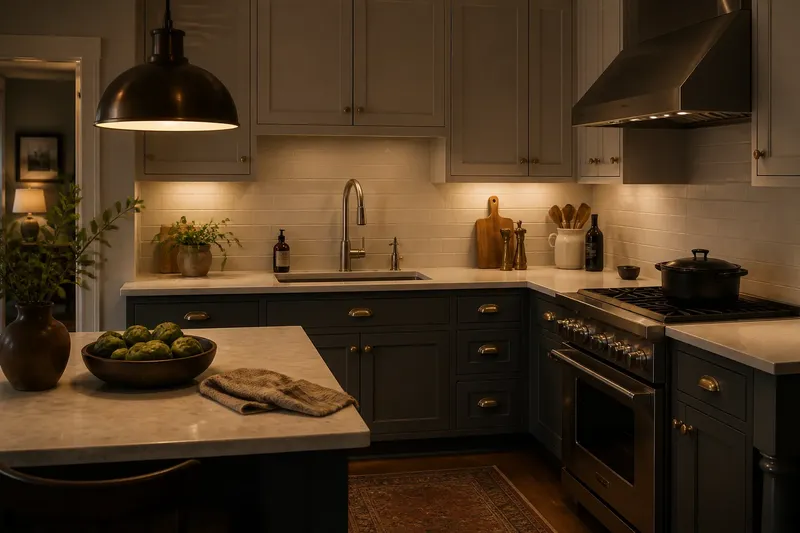
Mixed metal finishes can make a kitchen feel considered without replacing a useful faucet or cabinet hardware. If you are deciding whether every visible metal detail must match, start with the room’s shapes and the way its finishes relate, not with a demand for identical color.
What is making the kitchen feel unsettled?
Imagine a clearly hypothetical situation: you have a small kitchen with a brushed-nickel faucet, warm brass cabinet pulls, a dark bronze pendant, and a stainless-steel range hood. The pieces are all serviceable, but the different sheens and colors catch your eye separately, so the room feels less composed than you want.
That reaction does not automatically mean the finishes clash. Metal details can differ in color, reflectivity, and visual weight; the trouble often begins when each one seems to belong to a different design decision. Before changing anything, notice which pieces are prominent, which are repeated, and which are simply part of an appliance or fixture you need.
In this imagined kitchen, the faucet and hood are large, fixed elements, while the pulls and pendant are smaller. Treating the two fixed pieces as the room’s starting point gives the other choices a clear context instead of making every object compete for attention.
Which details should set the direction?
Sort the visible metals into three practical groups: fixed anchors, repeated details, and movable accents. A faucet, range hood, or built-in appliance may be hard to change; cabinet pulls repeat across the room; a fruit bowl, tray, or small lamp can be moved with little effort.
For the hypothetical kitchen, keep the brushed-nickel faucet and stainless hood as the fixed anchors. The brass pulls already repeat across the cabinet fronts, so they can read as a deliberate warm note rather than an isolated mismatch. The bronze pendant remains the most conspicuous question because its dark color and central position make it easy to notice.
Choose a direction for attention, not a finish that must appear everywhere. If the warm pulls are the detail you want to notice, avoid adding several unrelated shiny accents around them. If the pendant is the room’s focal point, let its darker finish remain distinct and keep smaller decorative metals quieter.
Can shape connect different metal finishes?
Yes. A repeated shape gives the eye a familiar outline to recognize, even when the materials have different colors. Look for forms such as rounded bars, narrow loops, straight cylinders, or softened corners—not just matching color names on packaging.
In the imagined kitchen, the cabinet pulls have rounded ends, and the pendant has a simple rounded profile. That shared curve helps the brass and bronze feel related without pretending they are the same finish. The faucet’s more angular handle can remain an independent functional detail, while the repeated cabinet pulls carry the room’s warmer note.
Shape works best when the resemblance is visible but not forced. A curved pull and a curved pendant can connect; two pieces do not need identical proportions or the same manufacturer. Walk through the room from the doorway and from the work area: if the repeated form is easy to notice, it is doing useful visual work.
When does contrast feel restrained?
Contrast feels deliberate when each finish has a clear role and the differences do not all demand attention at once. A warm metal beside a cool one can feel balanced when one is repeated in modest details and the other belongs to a larger, necessary fixture.
For this kitchen, keep the brass pulls as the recurring warm accent, let the nickel faucet and stainless hood remain functional cool-toned anchors, and avoid adding more bronze objects just to make the pendant’s finish appear elsewhere. The pendant can stay as a single darker accent if its silhouette relates to the rounded pulls and it does not dominate the view.
Surface sheen also matters. A polished finish throws sharper highlights than a brushed or aged surface, so several glossy metals may compete even when their colors are close. If a room already has a reflective appliance, a quieter finish on a new decorative object can soften the overall effect.
What should you check before changing anything?
- Identify fixed metals. Note appliances, faucets, and built-in fixtures you intend to keep; decide which new choices must work alongside them.
- Count repeated details. Look at cabinet pulls or other recurring pieces; decide whether their finish already provides a clear accent.
- Compare shapes. Look for a shared curve, bar, loop, or edge; use that form to connect finishes that differ in color.
- Compare sheen in the room. View each piece under its usual lighting; decide whether glare or reflection, rather than color, is causing the visual tension.
- Move small accents first. Temporarily relocate a tray, bowl, or lamp; decide whether the remaining metal details feel more settled before buying replacements.
- Check what can actually be changed. Consider attachment, finish care, and the manufacturer’s instructions; keep a useful fixture in place if a small styling adjustment can resolve the imbalance.
In the invented kitchen, the owner follows that last, low-disruption approach: the faucet and hood stay, the pulls remain, and a shiny bronze countertop object is moved to another room. From the doorway, the rounded pendant and pulls now create a visible connection, while the larger cool metals read as part of the kitchen’s working equipment. That is an expected observable result in the scenario, not a promise that the same arrangement will suit every room.
Which questions help you decide?
Do kitchen metals have to match?
No. Different finishes can sit together when their shapes, scale, or placement create a clear relationship. Matching everything is one option, not a requirement.
Can brushed nickel and brass work together?
They can, particularly when one finish repeats in smaller details and the other belongs to a fixed fixture. Compare both in the room’s actual light, since sheen can affect how strongly each stands out.
How many metal finishes can a room contain?
There is no fixed count that suits every room. Focus instead on whether each finish has a reason to be there and whether the most prominent pieces compete for attention.
What if the metals still look mismatched?
First move or remove a small decorative metal object and reassess the room. If the tension remains, consider changing one prominent, replaceable detail rather than replacing every fixture at once.
How can you apply the lesson beyond this kitchen?
In a living room or entry, use the same room-specific reasoning: notice which metals are fixed, which repeat, and which are easy to move. A lamp base, picture-frame edge, or furniture handle can relate to a nearby shape without copying its finish.
The matching-finish myth often turns a flexible decorating choice into a replacement project. Keep useful pieces, give mixed metals a visible connection, and change only the detail that is actually distracting. A room can feel cohesive because its objects relate, not because every surface agrees.