Why Repetition Makes a Room Feel Connected
Room color repetition can connect different furniture and objects. Learn where to echo a hue, shape, or material without making the room feel matched.
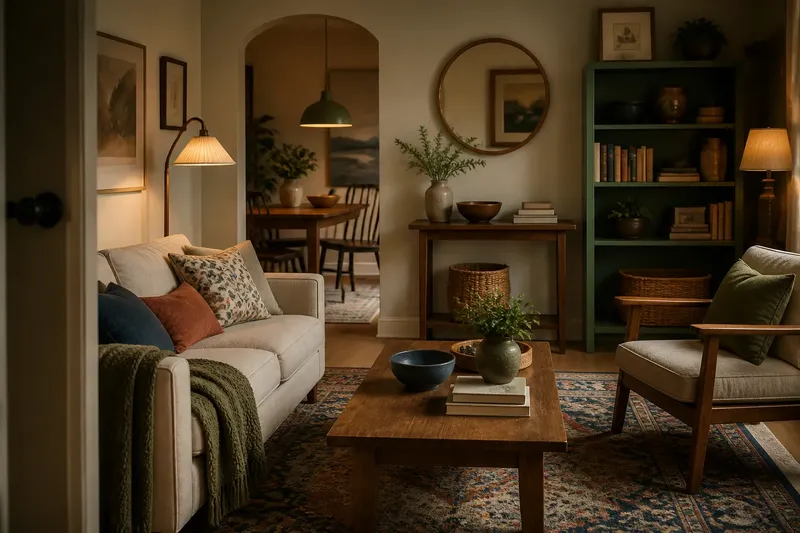
Room color repetition can make an old oak table, a painted bookcase, and a hand-me-down chair feel at home together without matching sets. The useful trick is to echo one detail in a few places, then let each object keep its own character.
That detail might be a muted green, a rounded edge, or the warm grain of wood. Use these numbered ideas to decide what to repeat, where it belongs, and when to stop.
1. What should you repeat first?
Start with something already present that you want the room to notice. It could be a color in a rug, the curved back of a dining chair, or the texture of a woven basket. Repeating that feature gives the eye a recognizable thread through the room.
Choose one main feature rather than trying to echo every attractive detail. If a patterned cushion contains rust, cream, and blue, pick one of those colors to carry elsewhere. The remaining colors can stay special to the cushion.
Look at the room from the doorway, where its larger relationships are easier to see. Note which color, shape, or material appears only once and could use a quiet companion.
2. How can you repeat a color without making a matching set?
Use the same color family on objects that differ in size, texture, or purpose. A deep blue on a cushion might reappear in a small framed print and the spine of a book. The echoes feel related, while the objects still look collected rather than bought together.
Color does not need to match exactly. A dusty green in a ceramic bowl can sit comfortably near a leafier green in a plant pot, especially if the room already contains warm wood or neutral fabric to give them space. Check the colors in daylight and under your usual lamps; a shade can look different as the light changes.
Spread echoes across the room rather than lining them up on one shelf. Imagine you have a cream sofa, a blue-and-rust rug, and a plain wooden coffee table. If you place a small blue bowl on the table and a rust-colored cushion at the far end of the sofa, the rug’s colors now appear in separate parts of the seating area without copying its pattern.
Repeat a color where it helps guide the eye, not simply wherever there is room for another object.
3. Which shapes are easiest to echo?
Shapes are often subtle enough to connect furnishings without adding more color. A round mirror, a circular tray, and a lamp with a curved shade can echo one another even when their finishes differ. Look for a clear outline that appears more than once, such as an arch, a soft corner, or a narrow vertical line.
Vary the scale and use of the shape. Several objects of exactly the same size and outline may look like a set; a large oval mirror beside a little rounded bowl feels more relaxed. Mix the repeated shape with straighter pieces so the room has contrast as well as continuity.
Consider the shape of built-in features too. A rounded doorway or curved sofa arm can provide a starting point for a smaller echo in a vase or picture frame. The furniture need not match the accessory; a shared outline is enough to create a visual link.
4. How do you repeat a material among different furnishings?
Materials bring texture and temperature as well as color. A room with a pale timber floor might use that same wood family in a stool, a picture frame, or a small serving board. The pieces need not share a stain, but similar grain and warmth can help them belong together.
Other useful materials include linen, cane, ceramic, leather, and stone. If a woven chair is the only rough-textured object, a basket or lampshade in a related weave can make the texture feel intentional. A smooth ceramic vase beside it adds contrast, so the room does not become uniformly coarse.
Think about wear before adding a material just for its appearance. In a busy entry, a sturdy basket may be a more sensible echo of a woven dining chair than a delicate woven ornament. For care, use the item's label or manufacturer instructions; finishes and fabrics can need different treatment.
5. Where should the echoes go?
Place repeated details in different visual zones: near the floor, around seated eye level, and higher on a wall or shelf. This lets the eye travel through the room instead of finding all the repetition in one cluster. A color found only among tabletop objects, for example, may not connect the table to the rest of the space.
Think about how the room is used as well as how it looks. In a living room, a repeated hue might appear in a rug, a cushion, and a lampshade, tying the seating area together. In a bedroom, the same idea could link a headboard, a bedside ceramic piece, and an artwork detail without requiring a matching nightstand.
Keep repeated objects useful when you can. A bowl can hold keys, a throw can add warmth, and a tray can gather everyday items; a room does not need extra ornaments solely to create an echo.
6. How many repetitions look intentional?
A feature that appears just once can seem accidental, while an echo in a few separated places is easier to read as a choice. There is no fixed count that suits every room: a bold color may need only a couple of appearances, while a quiet material can recur more often without dominating.
Pause before adding another piece. Look from the entrance and ask whether you can notice the repeated feature without searching. If it already carries the eye across the room, leave space for the other colors, shapes, and materials to contribute.
When repetition feels heavy, remove one echo rather than replacing every object. A single cushion or accessory can be enough to restore breathing room.
7. What should you ask before repeating a detail?
Can two different shades still read as one color echo?
Yes, if they share a recognizable character, such as muted blue or warm red. Nearby shades can feel connected without looking like an exact set, particularly when their textures differ.
Can a pattern count as a repeated color?
Yes. A small accent color within a rug or print can reappear as a solid object elsewhere, which often makes the link easier to see. Let the pattern remain the room’s more complex element.
What if the room already has several strong patterns?
Repeat a quieter feature, such as a wood tone or rounded outline, rather than introducing another prominent color. A restrained echo can connect patterned furnishings without competing with them.
How can you tell when repetition has gone too far?
If the room looks like every object was selected as part of one set, or your eye stops noticing the individual pieces, remove an echo or vary its scale. Keep the most useful or distinctive object and let its companions be less exact.
8. How can you build a connection from what you own?
Start with the furnishings and household objects already in the room. Choose one appealing feature, then move items around before buying anything: a colored book may work better on a side table, while a small basket might connect a chair to the wall nearby. A different placement can make an existing echo visible.
If the room still feels disconnected, look for a useful secondhand item that repeats the chosen feature but has a different shape or job. A small ceramic dish can echo a color in a painting; a timber stool can relate to a cabinet without pretending to be part of its set. Choose something that earns its place in daily use.
Room color repetition works best when it supports the pieces you already value rather than asking them to disappear into a coordinated scheme. Keep one clear thread, allow variations in shade and form, and let the room’s different objects remain different.